





In this guide:
- Basic blackjack strategy explained instantly
- Where the chart applies and the variations of blackjack you will find
- The complete strategy chart – hard hands, soft hands and pairs
- Three steps to reading the chart and the hands players argue about the most
- House edge maths showing what correct play is worth in money
Basic blackjack strategy is the mathematically correct decision for every possible hand you could be dealt against every possible dealer up card, hit, stand, double, split or surrender, based on the probabilities of the game and not on hunches. It is no system, no betting pattern and no card counting. It is only the answer sheet, calculated decades ago by computer analysis, and it never changes.
What do you benefit from it?
Cash.
The house edge is around half of one percent for a player using basic strategy. This is one of the lowest advantages of any casino game. A feel-decider typically gives 2%+ away. Same table, same cards, four times the price. The only difference is one chart.
This page shows you how to read the chart in three steps and walks through the hands that cause the most arguments at the table. No promise of victory, the house edge is always there, just the promise that you might skip errors you could have avoided.
First Blackjack Variations You Will Encounter
Well before the strategy: a quick map of where you’ll use it. These all have the same core rules, so the basic strategy is the same for all of them:
- Classic blackjack – the regular game, on RNG tables and across the live casino studio floor. Seven seats, dealer plays fixed rules, and everything in this article directly applies.
- Speed Blackjack – same rules, faster deal. Quickest decision-makers go first. Great for chartists, harsh for fence-sitters.
- Lightning Blackjack – pays out randomised multipliers on wins, for a fee on each hand. The strategy is the same. The economics move a bit toward variance.
- Infinite Blackjack – unlimited seats, everyone plays the same dealt hand their own way. The easiest place to practise chart decisions in live play.
- Free Bet Blackjack – the casino will pay for certain doubles and splits. The trade-off is that the dealer pushes on 22. There are chart changes, but the basic chart is a good place to start.
- RNG blackjack – software-dealt, private and played at your own pace, like this blackjack table at our online casino. The perfect training room – chart open on one side of the screen, game on the other, no one waiting for you.
If the live format itself is uncharted territory, our guide on what a live casino is explains how streamed tables work before you sit down.
Blackjack Strategy Chart
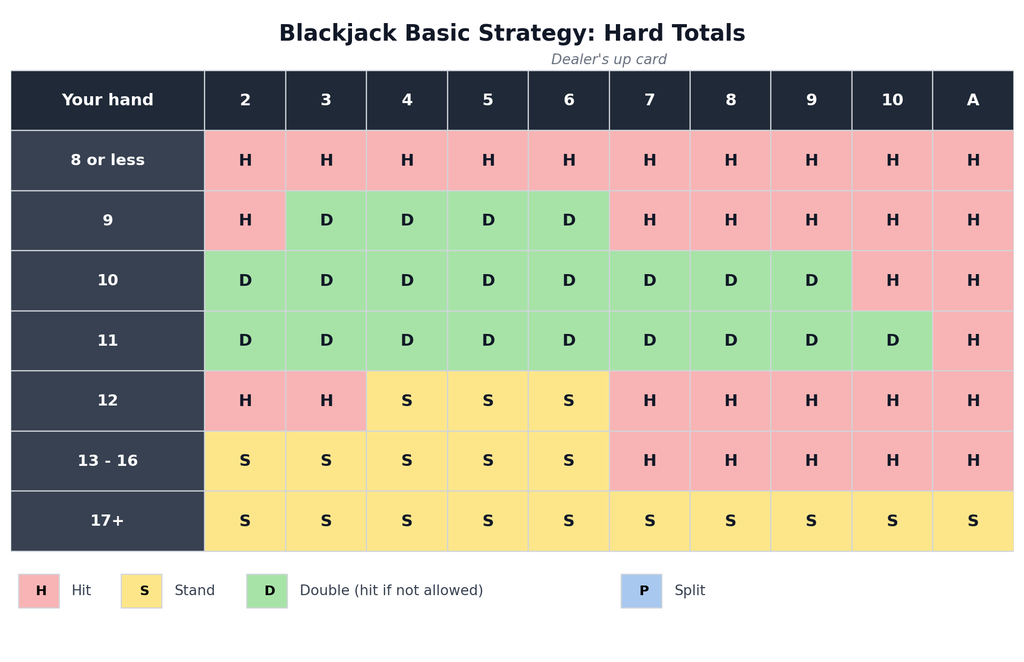
The chart below assumes the most common rules: four to eight decks, dealer stands on soft 17, doubling after splits allowed. The core never moves. Check your table’s rules panel, a couple of cells move under other rule sets.
Soft Hands (What Are Hard and Soft Hands?)
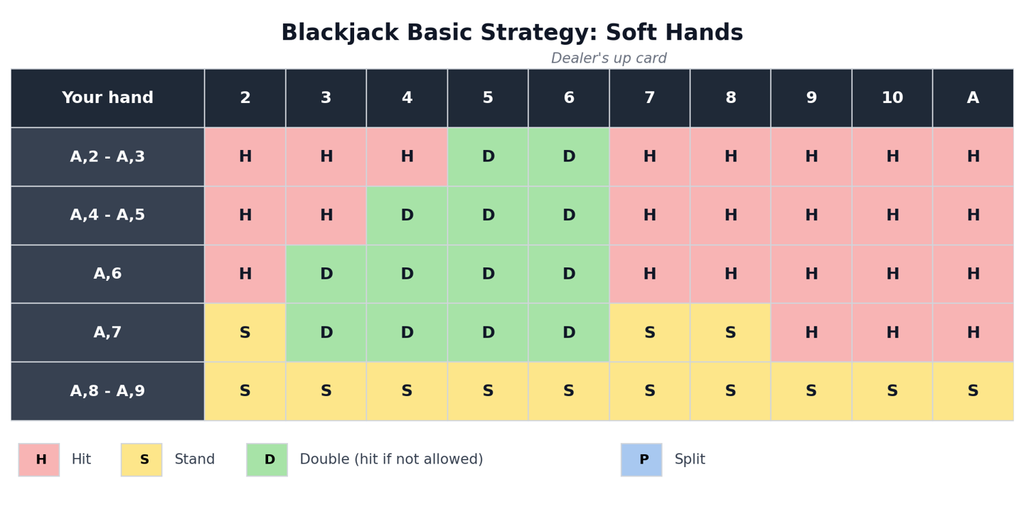
A soft hand is one where an ace counts as 11 (A,6 is soft 17), so you can’t bust by drawing to it. Quick definition, but that’s what the chart is based on. A hard hand has no ace, or an ace that counts as one. The chart explains why soft hands are a lot more aggressive.
Pairs
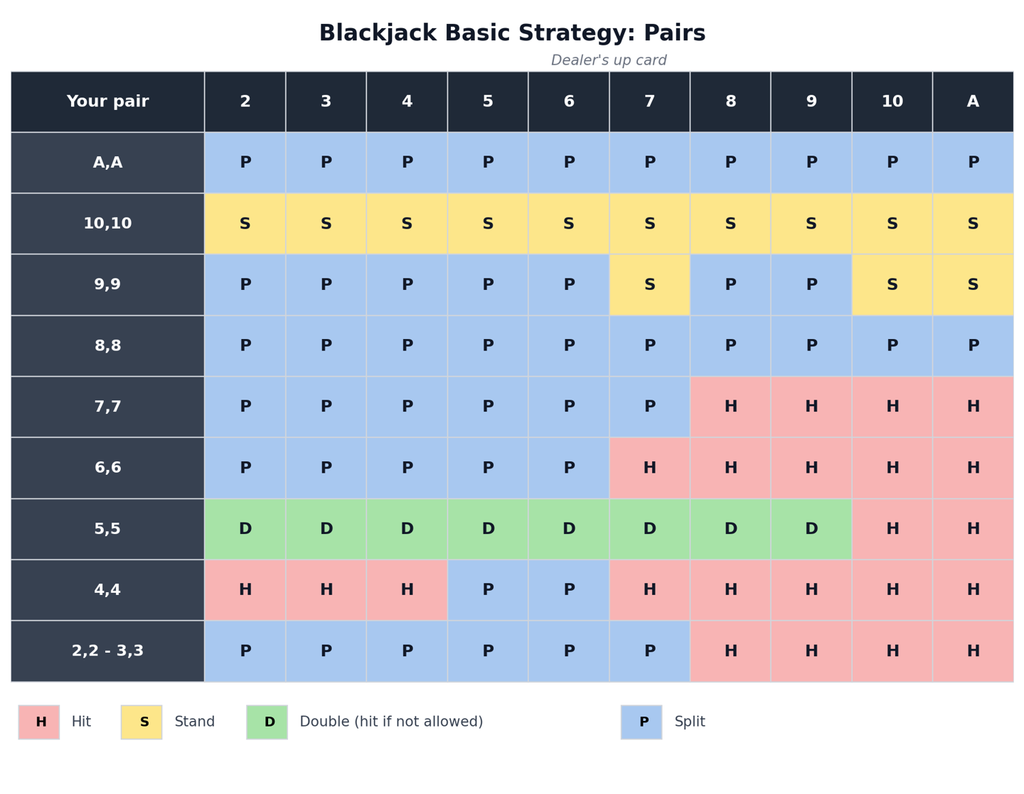
How to Read the Chart in 3 Easy Steps
- Put your hand in the left column – hard total, soft total or pair.
- Locate the dealer’s up card in the top row.
- Play the letter they land on.
Play like that every hand and you are already playing better blackjack than the vast majority of people at the table.
When to Hit or Stand in Blackjack
The most important part of the chart is based on this logic: stay on 12-16 only when the dealer has a weak card (mainly 2-6) and is likely to bust, hit those same totals against a strong card (7-A), because the dealer will usually finish with 17 or better and your 14 loses standing still. “Never chance busting against a weak card” has a famous exception: hard 12 against a 2 or 3 – the maths say hit.
When to Double Down in Blackjack
Double if one card will probably give you strength and the dealer is probably going to finish weak. The crown jewel here is hard 11: double against anything but an ace. Hard 10 doubles for 2-9, hard 9 for 3-6, and soft hands double aggressively for dealer 4, 5 and 6, the three cards that bust the dealer most often. Here is where basic strategy makes its money. Doubling. The cost of missing these spots is greater than any other timid habit.
When to Split in Blackjack
There are two rules which cover most of this. Split aces and eights, always. Never split fives and tens. Aces, because a hand of 12 loses to two hands beginning with 11. Eights, because 16 is the worst total in the game, and splitting gets you out of it. Never tens because 20 wins already. Never fives, because 10 is a doubling hand, not two weak hands. The other pairs are laid out according to the chart. The only curiosity is 9,9. Split vs most cards. Stand vs 7, your 18 beats the dealer’s most likely 17.
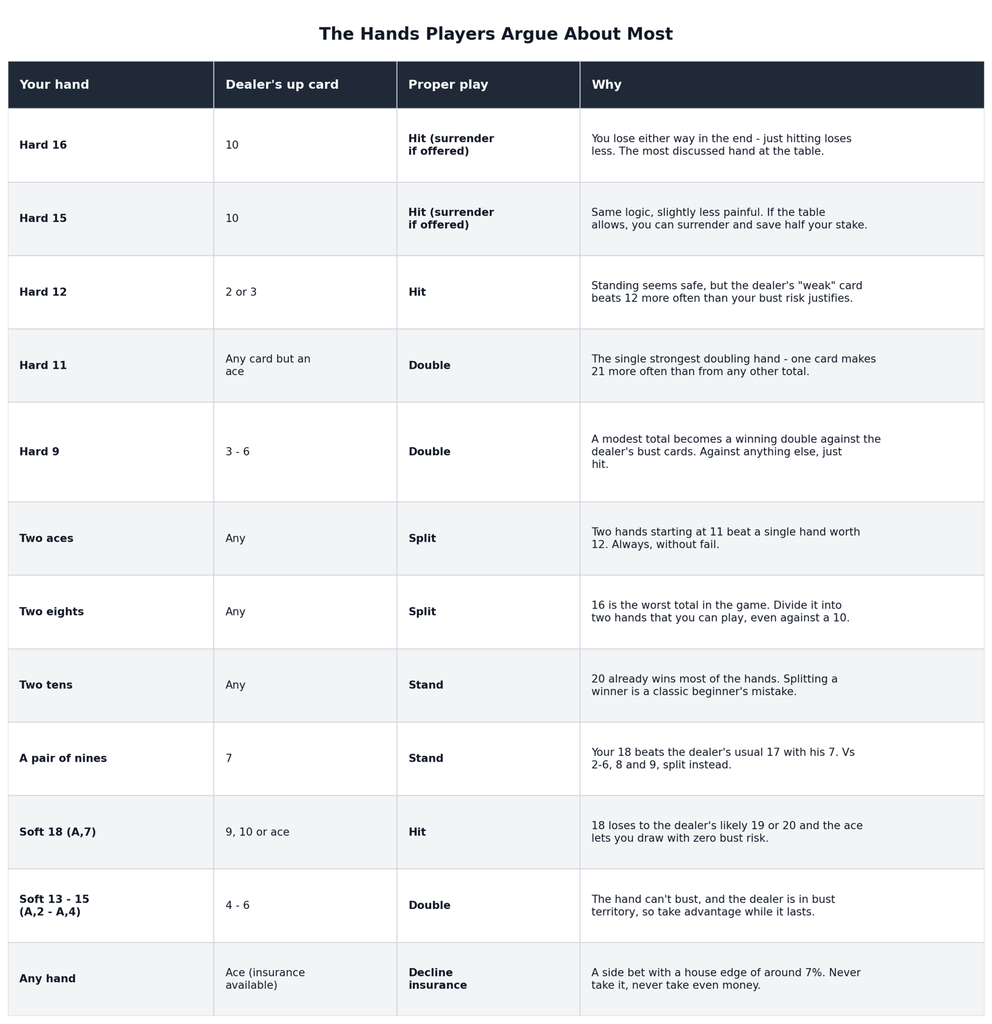
The Hands Players Argue About Most
The scenario decisions that separate chart players from feel players:
Blackjack House Edge: What 0.5% Actually Means
It’s time to price the chart. Blackjack has a house edge of about 0.5% if you play perfectly under standard rules – that’s the number that comes from the strategy tables calculated at Wizard of Odds, the mathematical reference on this subject.
If we speak of money: for every 100 EUR you bet in a session, correct play will cost you about 50 cents in expectation. Play by instinct at a typical 2% error rate and the same 100 EUR costs about 2 EUR.
The chart doesn’t make you win, it makes losing four times cheaper, which is the best deal in the building. That edge translates to an RTP around 99.5% – our help page on what RTP means explains the term, and the guide to odds in the casino shows how blackjack compares with everything else on the floor.
Basic Strategy, Not Card Counting
It’s good to keep them apart, as people are always mixing them up. Card counting is the skill of tracking the ratio of high- to low-value cards left in the shoe, betting more when the count is in the player’s favour, a legal skill that live studios successfully combat with frequent shuffles and cut cards.
The basic strategy involves no tracking, no remembering past hands, and no changing your bets. It’s just right play, hand by hand, and no casino anywhere objects to it. Keep the chart open next to an RNG table, or on your phone at a live one – as a licensed OlyBet casino and sportsbook provider we want you to play well and stay longer.
FAQs
What is basic blackjack strategy?
Based on probability analysis, it is the mathematically optimal decision – hit, stand, double, split, or surrender – for each possible combination of player hand and dealer up card. Following it lowers the house edge to around 0.5% on standard rules. It only impacts the price of your game, not who deals the cards.
Can I use a blackjack strategy chart?
Certainly. Looking at a chart does not break any rule at RNG tables or live ones. The basic strategy is public maths. Casinos hate card counters. The strategy chart is simply a record of the right play and its use is the standard advice for every new player.
Does basic blackjack strategy really work in online blackjack?
Yes – the probabilities are the same, whether it’s a croupier dealing from a shoe or software dealing from a shuffled virtual deck, so the chart remains unchanged. But it won’t beat the house edge. Look for cheaper sessions and better decisions, but never guaranteed profit.
Play Responsibly
Basic strategy reduces the cost of playing, but never eliminates it. There’s a house edge on every hand, so think of blackjack as entertainment for a known price, set deposit limits before you sit down, and walk away the moment the chart stops being fun to follow. OlyBet’s OlySafe hub has limit tools and self-assessment tests. Our guide there, on how to play responsibly should be read by every player, chart or no chart.
The Bottom Line
The cheapest skill in the casino is basic blackjack strategy: one chart, three steps to read it, and a house edge cut from 2% or worse to about 0.5%. Learn the big rules first – split aces and eights, never split tens, double hard 11, hit 16 against a 10 – and let the chart do the rest. When decisions start feeling automatic, bring them to the table.